

Strong Public Schools Strengthen Minnesota’s Communities

Public schools are at the heart of Minnesota communities.
Each morning when the bell rings, Minnesota public schools serve the vast majority of students in each Minnesota community. After school gets out, Minnesota public schools are networks of community activity. They connect families, provide programs and services to support families and community residents throughout different stages of life, and are spaces where groups can gather and be active.
More than 8 in 10 Minnesota students attend traditional public schools.
Minnesota school choice and has expanded families’ educational options for more than three decades. Through those changes, traditional public school systems have remained the foundation of education across the state. They continue to serve more than eight in 10 Minnesota students.
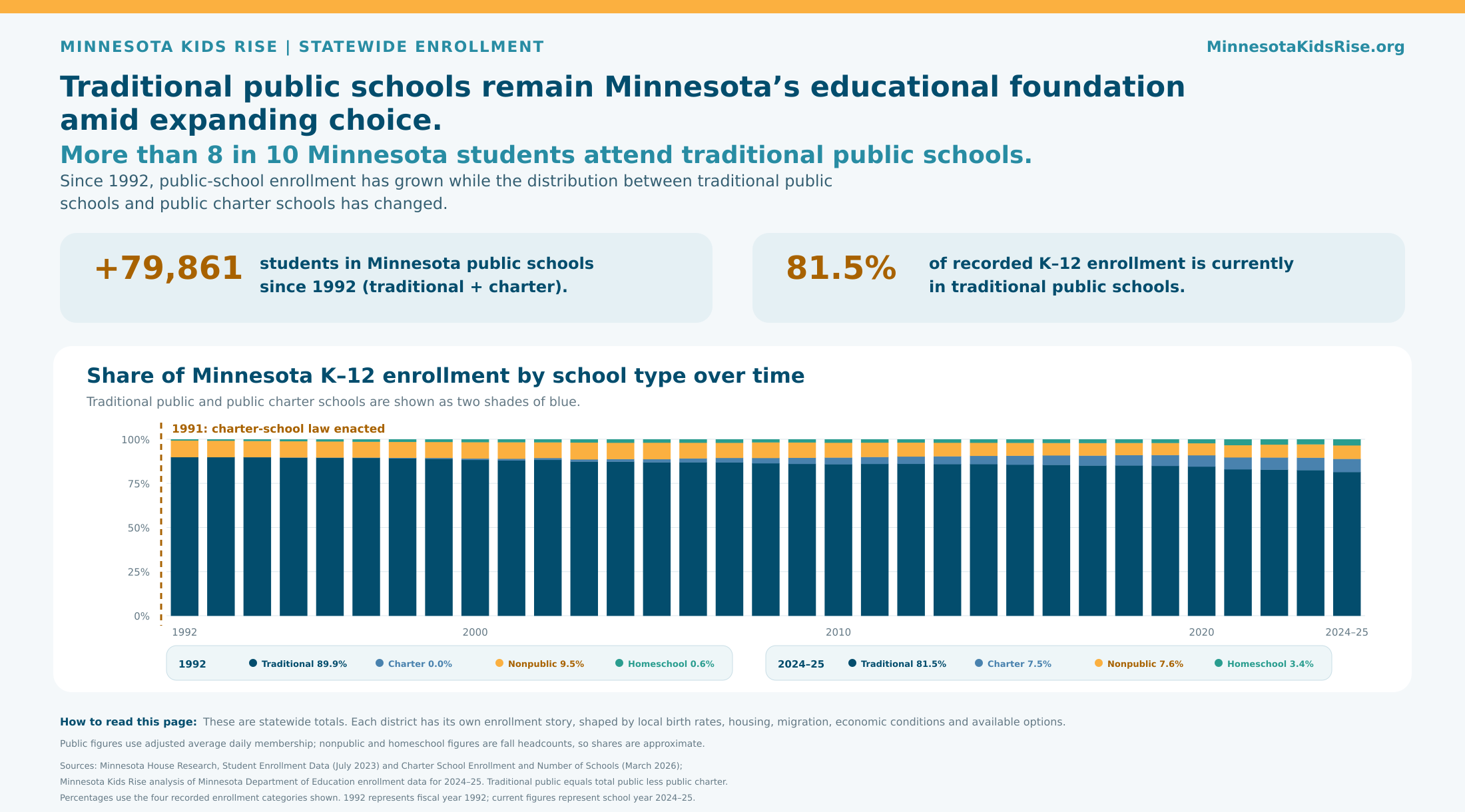
Sources: Minnesota House Research, Student Enrollment Data (July 2023), house.mn.gov/hrd/issinfo/EnrollmentData_2023.pdf; Minnesota School Finance: A Guide for Legislators (November 2025), house.mn.gov/hrd/pubs/mnschfin.pdf; Charter School Enrollment and Number of Schools (March 13, 2026), house.mn.gov/comm/docs/aZ7J2fEo5EyXCGMU0w_9-Q.pdf. 2023-2025
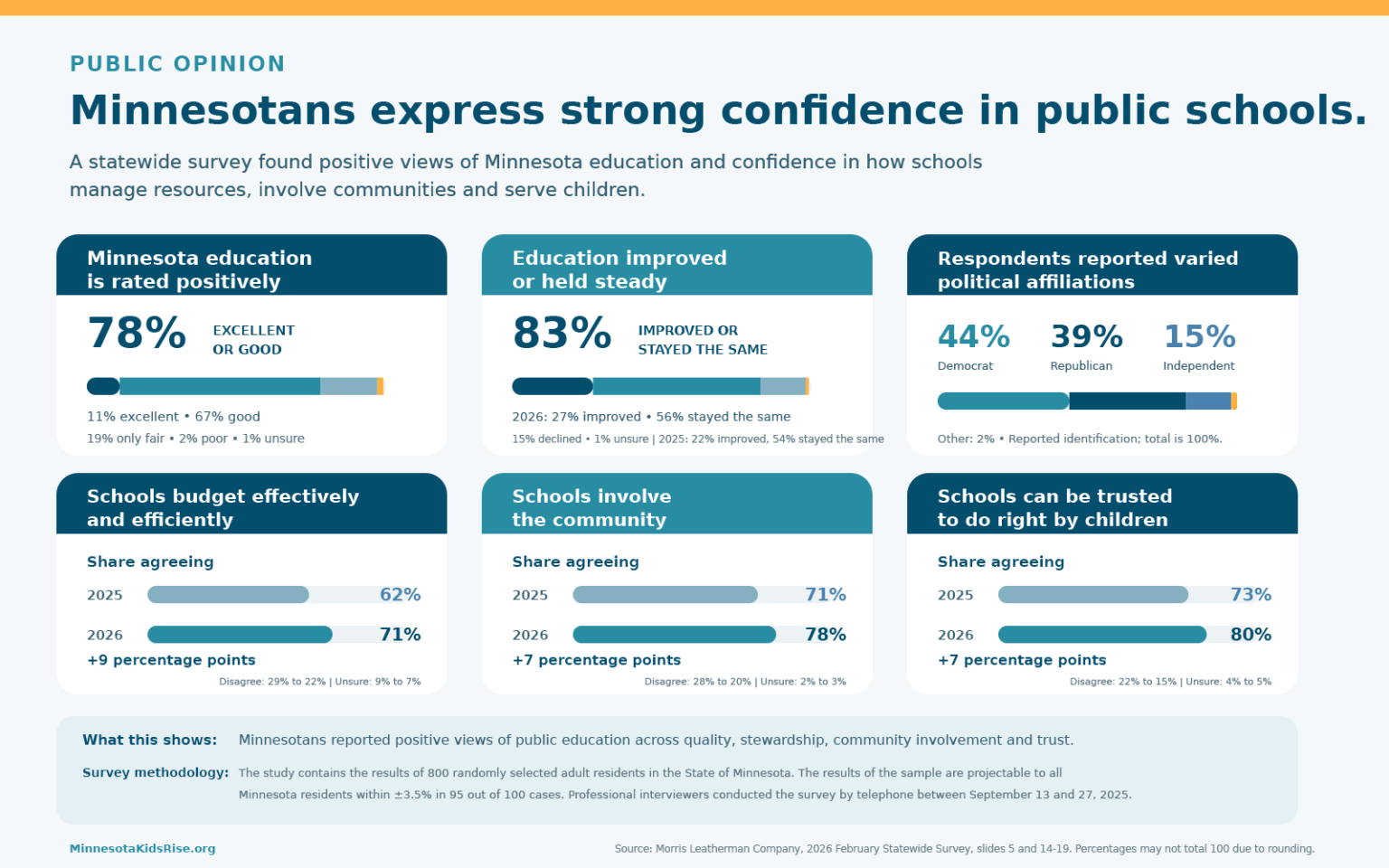
80% of Minnesotans express trust in their public schools.
78% of Minnesotans believe their district does a good job involving the community.
Minnesota has a comprehensive public-school Community Education system that supports learners and families across the lifespan.
Nearly 500,000 Minnesota adults participated in community education, including more than 45,000 adults with disabilities. Minnesota’s adult-education network also serves approximately 50,000 learners annually. These services are crucial in our state where nearly one in five residents is 65 or older, approximately 668,000 Minnesotans have a disability, and 12.4% speak a language other than English at home.
- Nearly 500,000 adults participated in public school community education programming in the 2024-2025 school year.
- 45,000+ adults with disabilities participated in community education programs.
- Approximately 50,000 adults use Minnesota Adult Basic Education annually – including about 25,000 English-language learners
Sources: Minnesota Department of Education, Community Education Annual Report data, 2024–25. Minnesota State Demographic Center, Minnesotans with Disabilities: Demographic and Economic Characteristics, February 2026, based on the U.S. Census Bureau’s 2023 American Community Survey.
Minnesota public schools begin supporting children long before kindergarten.
Public schools are often among the first places Minnesota families turn for support, community, and information about their child’s learning and development. Through Early Childhood Family Education, developmental screening, early childhood special education and district preschool, schools connect young children and their caregivers with learning opportunities and support before the first day of kindergarten.
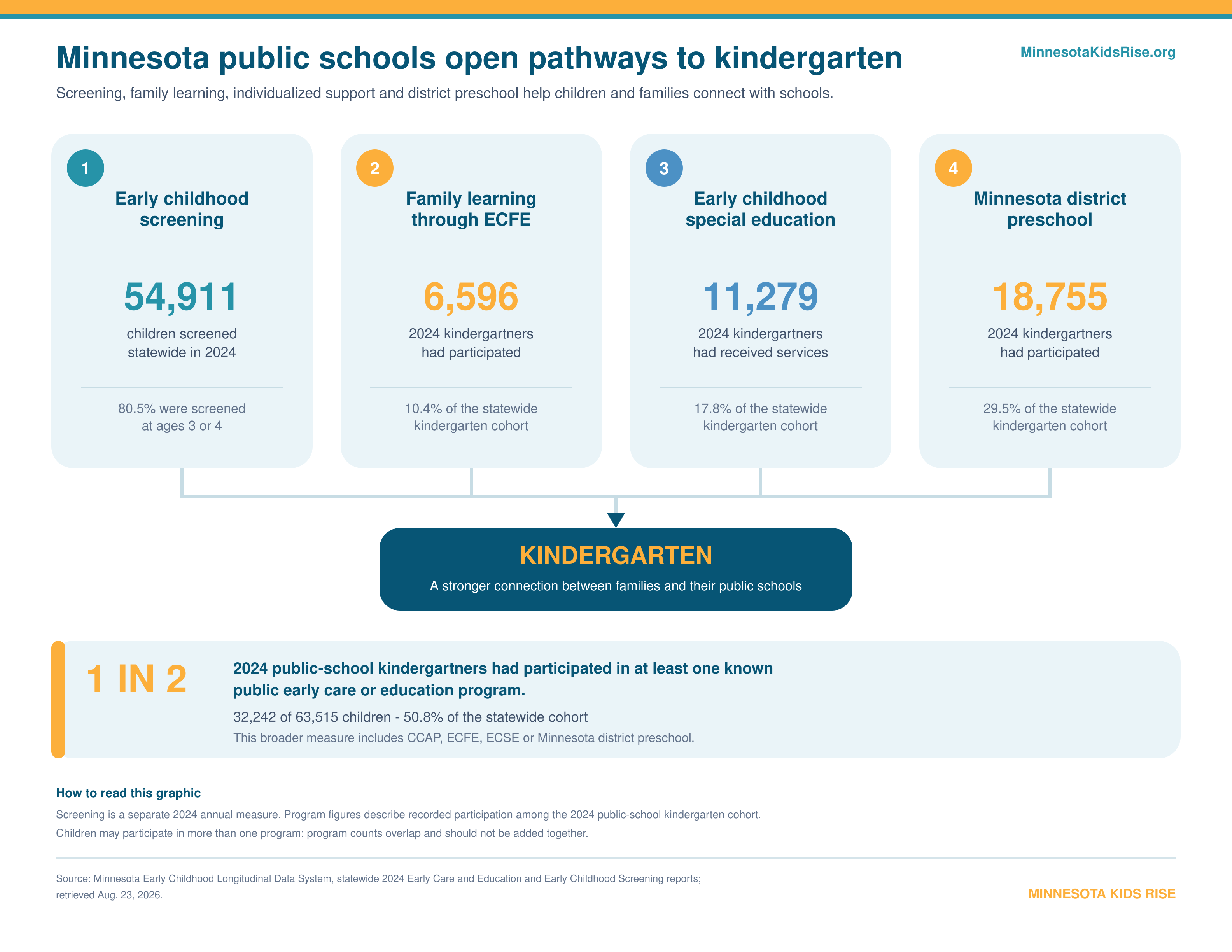
Source: Minnesota Early Childhood Longitudinal Data System, statewide 2024 Early Care and Education and Early Childhood Screening reports; retrieved Aug. 23, 2026.
3.76 million hours.
Minnesota’s public schools serve their communities long after the school day ends.
That is more than 10,000 hours of community use every day statewide. Minnesota public-school buildings were used by district and community groups for 3.76 million hours during the 2024–25 fiscal year.
Minnesota Kids Rise analysis of Minnesota Department of Education, fiscal year 2025 Community Education Annual Report data submitted by Minnesota school districts. Facility-use totals exclude regular district PK–12 programs and community education programming.