

Students Learn and Achieve

Learning takes many forms. So does measuring academic success.
Minnesota students build knowledge and skills in classrooms, labs, workshops and learning experiences across the state. Looking across multiple measures gives us a more complete understanding of what students know, how they are growing and the opportunities available to challenge themselves. So, how are Minnesota students performing?
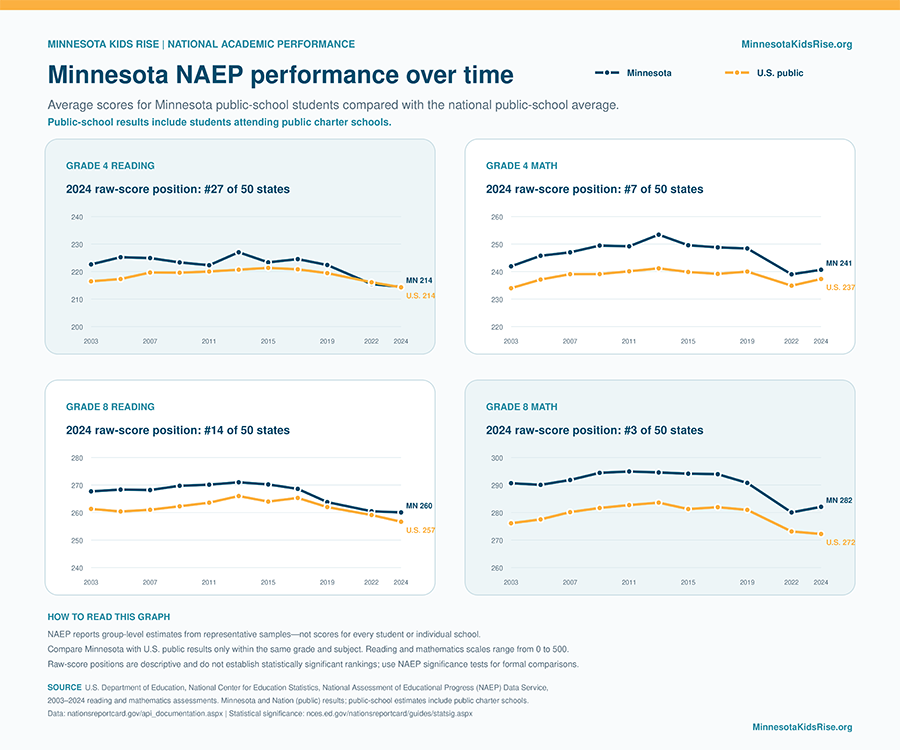
Minnesota’s public 2024 National Assessment of Educational Progress scores were above the national public-school average in three of four grade-and-subject measures.
Minnesota students build knowledge and skills in classrooms, labs, workshops and learning experiences across the state. Looking across multiple measures gives us a more complete understanding of what students know, how they are growing and the opportunities available to challenge themselves. So, how are Minnesota students performing?
- Minnesota’s Grade 4 math score of 241 was higher than the national score of 237 and ranks #7 out of all 50 states.
- Minnesota’s Grade 4 reading score of 214 was the same as the national public-school score of 214 and ranks #27 out of all 50 states.
- Minnesota’s Grade 8 reading score of 260 was higher than the national score of 257 and ranks #14 out of all 50 states.
- Minnesota’s Grade 8 math score of 282 was significantly higher than the national score of 272 and ranks #3 out of all 50 states.
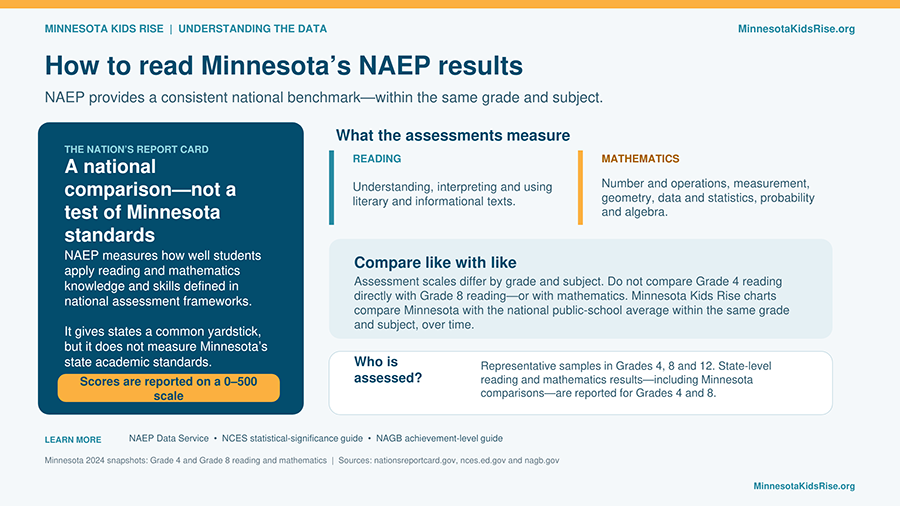
Source: National Center for Education Statistics. National Assessment of Educational Progress (NAEP), reading and mathematics assessments, various years through 2024. Minnesota results compared with the national public-school average within the same grade and subject. Results include students attending traditional public schools and public charter schools. Data retrieved through the NAEP Data Service and verified against the 2024 Minnesota State Snapshot Reports.
Minnesota combines broad ACT participation with strong performance. 68% of Minnesota’s 2025 graduates took the ACT, compared with 36% nationally. Minnesota’s average Composite score was 20.6 — second highest among states where at least 60% of graduates tested.
Minnesota is:
- Among states where a high percentage of graduates took the ACT, Minnesota’s average Composite score ranked second—behind only South Dakota.
- Minnesota also ranked second among high-participation states in the percentage of students meeting the college-readiness benchmarks in at least three of the ACT’s four subject areas.
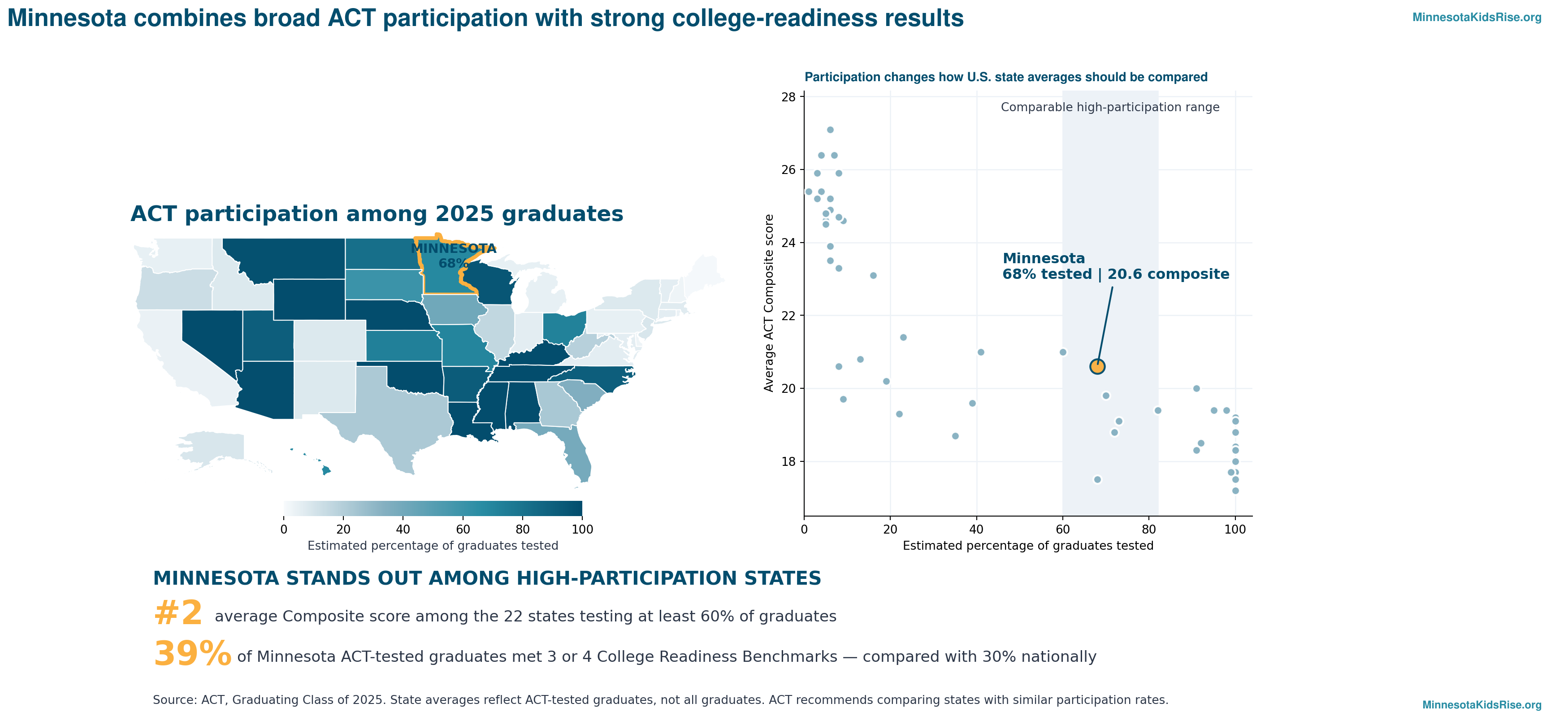
ACT explicitly recommends comparing states with similar participation rates because its graduating-class data are not nationally representative and state testing populations vary considerably. ACT’s interpretation guidance explains this relationship.
Source: National Center for Education Statistics. National Assessment of Educational Progress (NAEP), reading and mathematics assessments, various years through 2024. Minnesota results compared with the national public-school average within the same grade and subject. Results include students attending traditional public schools and public charter schools. Data retrieved through the NAEP Data Service and verified against the 2024 Minnesota State Snapshot Reports.
Rigor takes many forms – and Minnesota students achieve at high levels across many pathways.
Every student deserves opportunities that challenge them, build on their strengths and connect learning to their aspirations. In Minnesota public schools, rigorous learning includes college-level courses, internationally recognized programs, career and technical education, advanced research, artistic performance, design and applied problem-solving.
No single program defines high achievement. Together, these pathways show how public schools help students pursue excellence and prepare for college, careers and life.
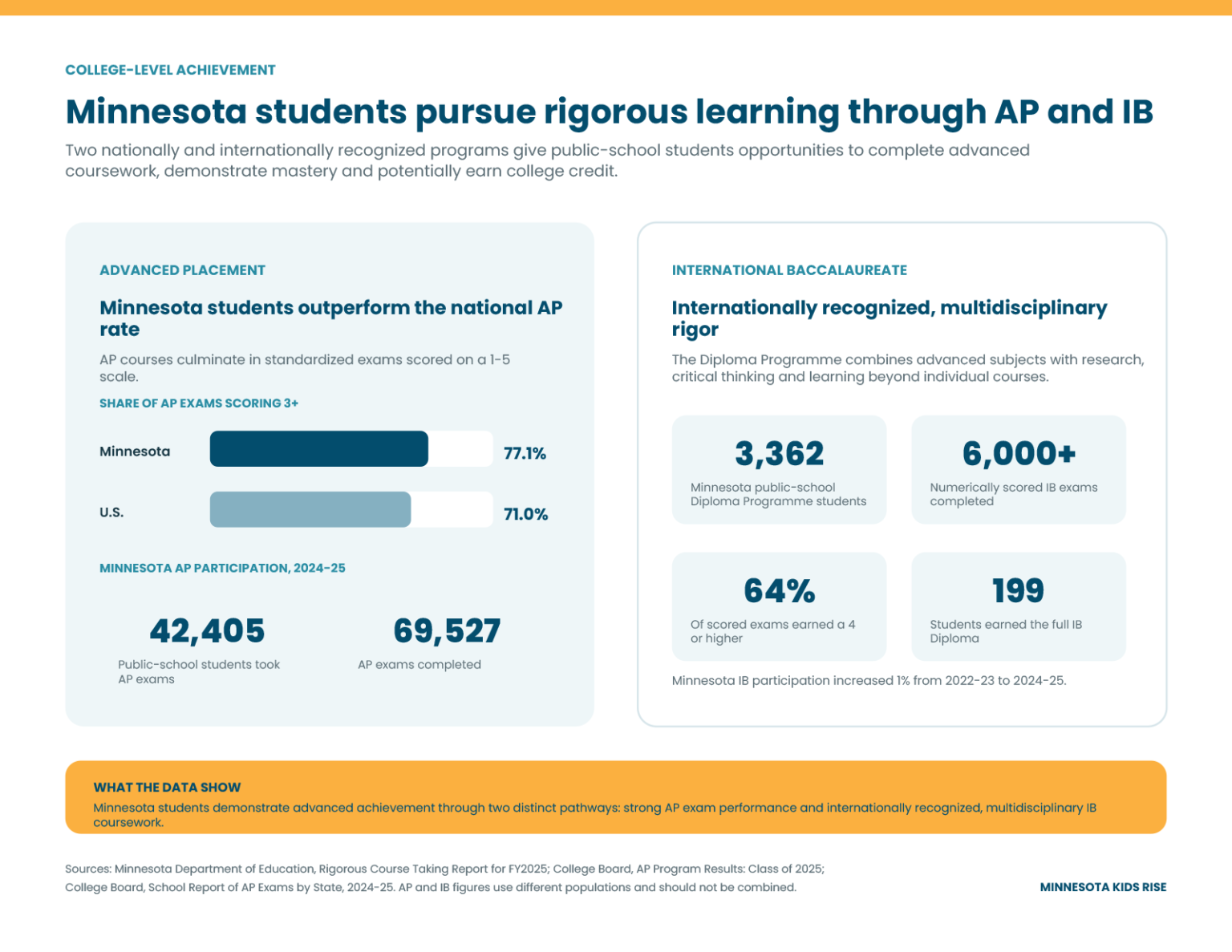
Minnesota students succeed in nationally recognized advanced coursework.
Minnesota students outperform the nation on Advanced Placement exams.
The International Baccalaureate Diploma Programme combines advanced coursework with independent research, critical thinking and learning across subject areas.
There is no nationally normed IB data available.
Source: Minnesota Department of Education, Rigorous Course Taking Report for FY2025; College Board, AP Program Results: Class of 2025; College Board, School Report of AP Exams by State, 2024-25. Minnesota Department of Education, Rigorous Course Taking: Advanced Placement, International Baccalaureate, Concurrent Enrollment and Postsecondary Options Programs—2026 Report to the Legislature, using International Baccalaureate Organization data for fiscal years 2022–2024. AP and IB figures use different populations and should not be combined.
Career and technical education (CTE) connects rigorous learning to real work.
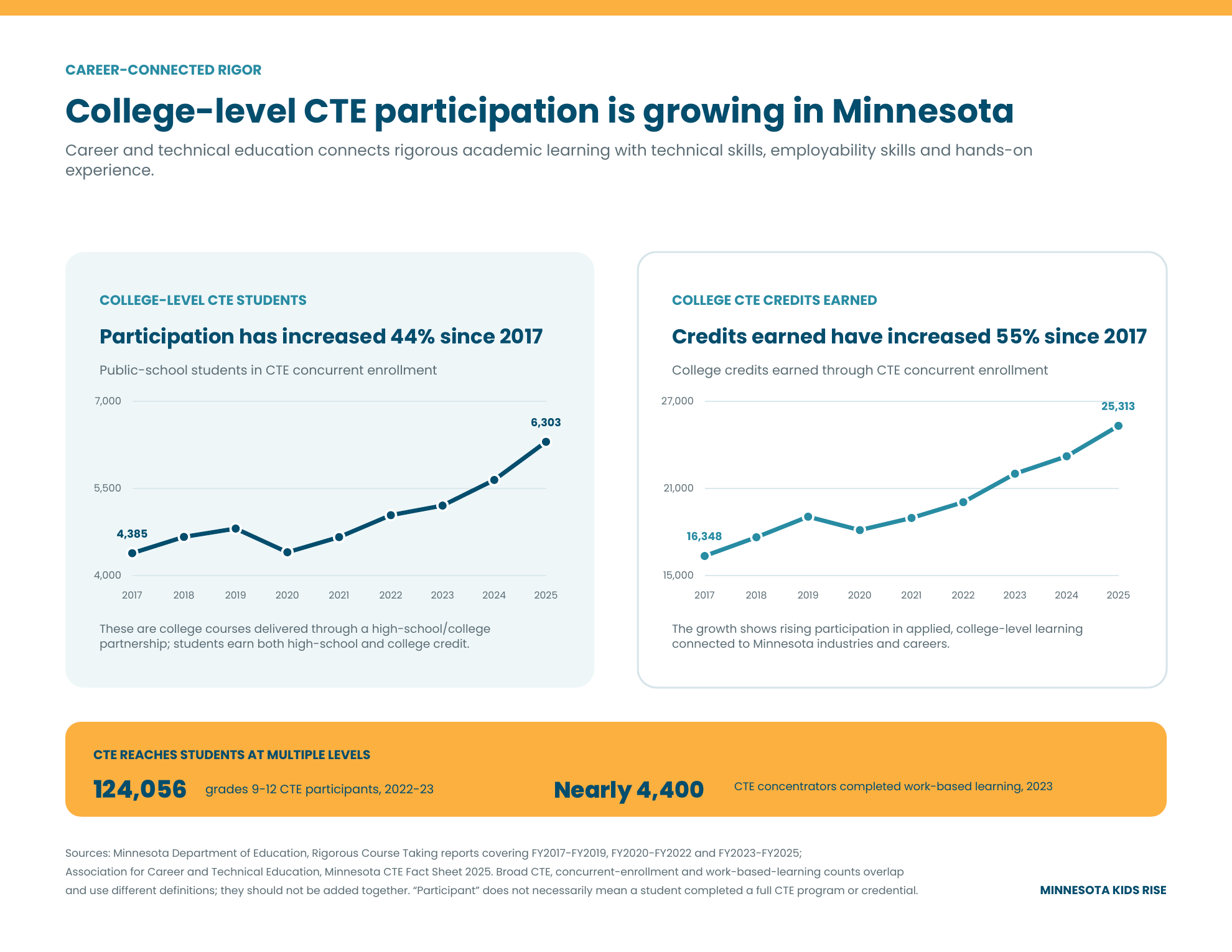
Public school student participation in college level CTE courses has increased 44% since 2017. CTE courses give students another way to undertake challenging work while exploring how their learning connects to Minnesota’s economy.
What CTE means
Career and technical education, or CTE, combines academic knowledge with technical, employability and hands-on skills. Programs may include health sciences, engineering, information technology, agriculture, construction, manufacturing, transportation, business and other fields.
Source: Minnesota Department of Education, Rigorous Course Taking reports covering FY2017-FY2019, FY2020-FY2022 and FY2023-FY2025; Association for Career and Technical Education, Minnesota CTE Fact Sheet 2025.
Rigor also includes creation, performance and design and Minnesota public school students achieve at high levels through the arts, performance and design.
- Minnesota is therefore among the 25 of 50 states with an explicit arts requirement for high-school graduation. Among schools reporting complete data, 84% of students had access to at least one arts area, with music and visual or media arts the most commonly available.
Source: Minnesota Arts Education Data Project, using Minnesota Department of Education Minnesota Common Course Catalog and MARSS enrollment data. The project is administered by the Perpich Center for Arts Education in partnership with MDE and Creative Minnesota. Link to the Minnesota Arts Education Data Project